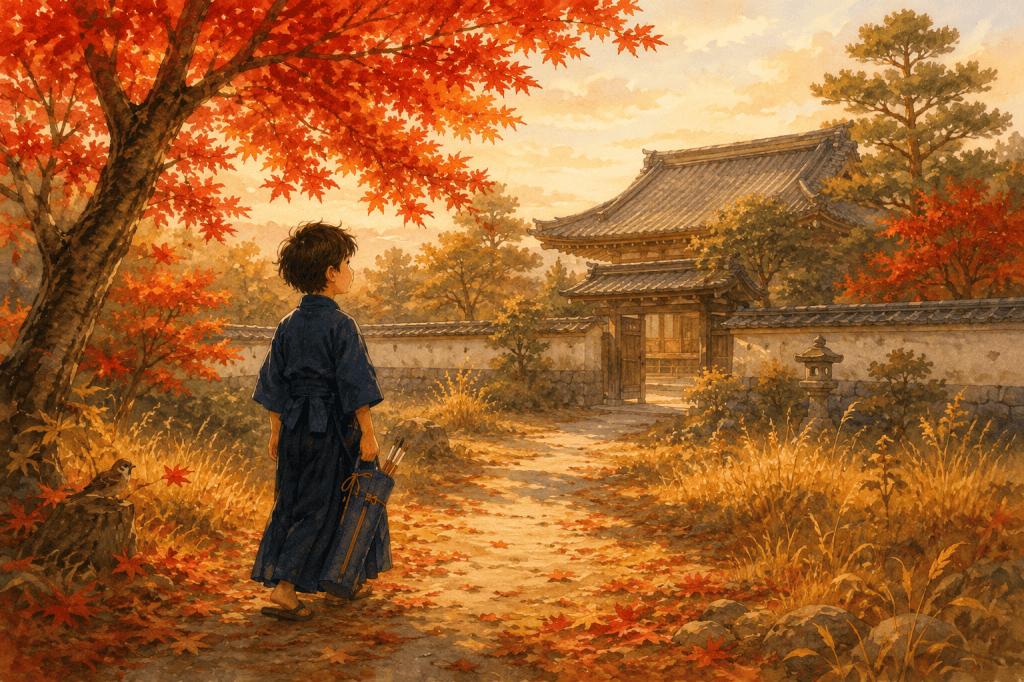
• Autumn arrived without knocking. It slipped red into the maple leaves, gold into the grass, and a cool quiet as placeholders of summer’s bustle. Carlos walked toward the dojo with his practice bag at his side, thinking about the part of Kyudo he had been waiting for to understand most of all: Hanare. Release.
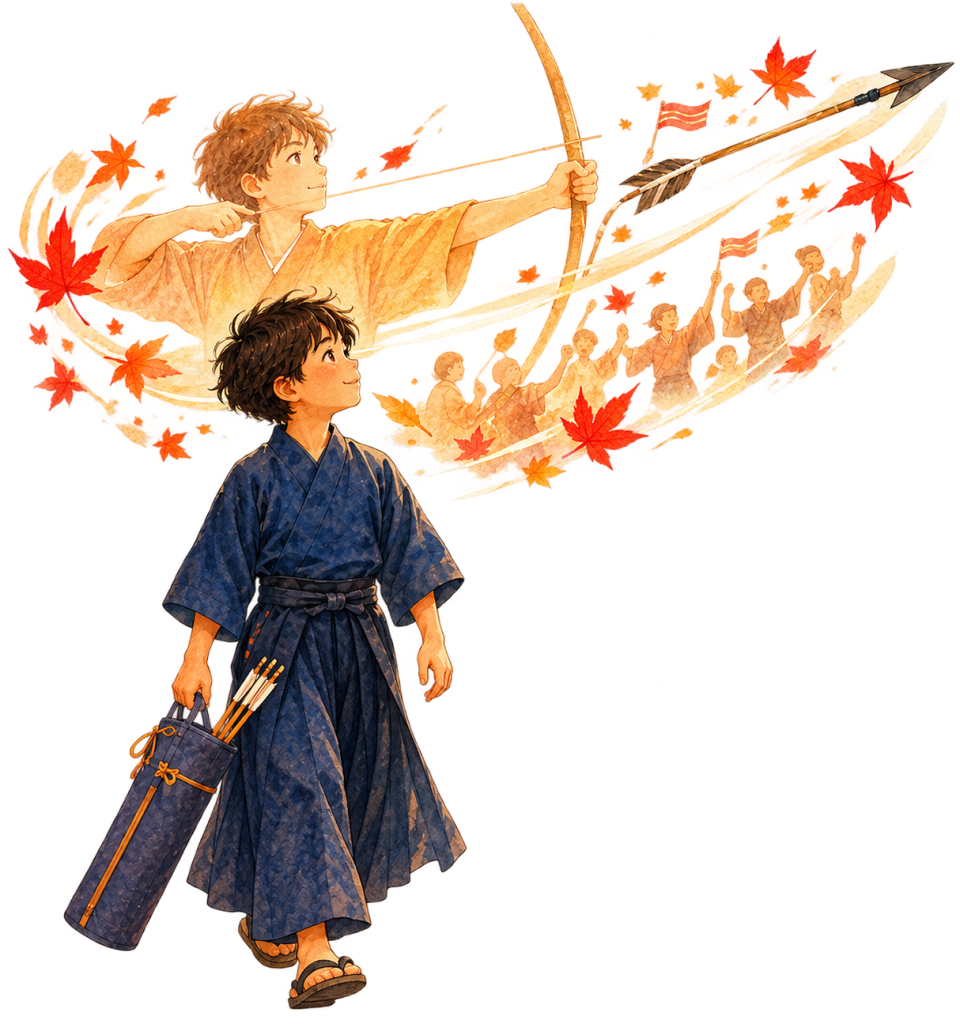
    He had practiced placing his feet. He had learned to stand tall enough to bend. He had prepared the bow, raised it, opened the draw, and met the full moment. Now, at last, the arrow would fly correctly and true. Carlos imagined it happening like a tiny festival in his fingers.

    Near the garden wall, Carlos stopped beneath a maple tree. One bright red leaf dangled at the end of its thin branch. A breeze came and went. The leaf shook a little but stayed. Another breeze came, stronger this time. Still the leaf remained, turning a little in the light.
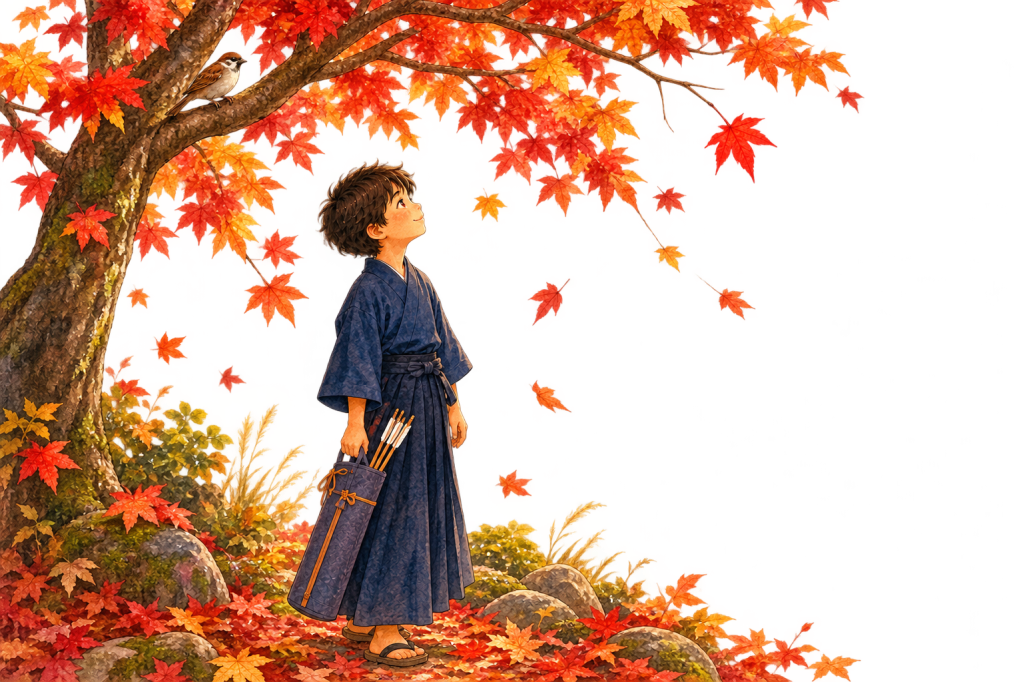
    “Why don’t you fall?” Carlos whispered. A sparrow hopped through the leaves on a distant maple, scratching at the red and gold canopies. It startled at Carlos’s voice, fluttered up, and landed on a higher branch that was a bit closer to Carlos while he crouched. The maple leaf waited with them both.

    At the dojo side of the garden, Mr. Tanaka was raking fallen leaves into a soft pile beneath the dojo eave. His rake moved slowly, gathering only what had already let go. Carlos watched the red leaf still holding above them.

    “Couldn’t you shake the branch?” Carlos asked of the sparrow. “Then the leaf would fall faster.”

    Mr. Tanaka leaned on the rake. “If the sparrow pulls a leaf before it is ready,” he said, “how has he honored autumn?”

    Carlos looked at the branch again. The leaf was not lazy. It was not stubborn. It was simply waiting for something Carlos could not wait to see yet.

    Before practice began, Carlos found a small seedpod on the garden path. It had stuck to his sleeve, hooked there by a tiny brown point. He tried to shake it loose. It stayed. He pinched it between two fingers and tugged. It seemed to cling tighter.

    Mr. Tanaka watched him for a moment. “If you pull harder against the nature of it,” he asked, “will it let go sooner or will you have had it do something unnatural?”

    Carlos stopped tugging. The seedpod rested against the cloth. He saw how the seed inside would normally pass from the sleeve. When he loosened his fingers and brushed downward instead of pulling out, it slipped free and fell into his palm.

    “Some things leave best when they are not being chased,” Mr. Tanaka said, returning to his rake.

    Inside the dojo, the room held the amber light of late afternoon. Carlos bowed, stepped to the line, and let the earlier stages arrive. Ashibumi placed his feet. Dozukuri built his body. Yugamae prepared his hands and eyes. Uchiokoshi lifted the bow. Hikiwake opened him wide. Kai filled the moment until his breath felt round and quiet.

    Then came the part Carlos had been waiting for: Hanare.

    Only now that he had arrived there, it did not feel like a tiny festival in his fingers. It felt like a tiny knot.

    Carlos waited for the arrow to leave. Nothing happened. He told his fingers to open. They became very keen in holding on. He told his shoulders to stay relaxed. They pretended not to understand and let impatience seep in. The more he wanted the release to happen, the farther away it seemed to move. If only something could startle him from being a statue.

    Kenji-senpai stood near him, quiet enough that Carlos could hear the string, his own breath, and a maple leaf scraping softly on a steppingstone outside the open door. The second one Carlos felt.

    “Carlos,” Kenji-senpai asked, “is the arrow leaving from your fingers, or from the whole you?”

    Carlos lowered the bow carefully. His fingers tingled with all the trying they had done. He looked toward the garden and saw the red leaf still hanging at the end of the branch.

    The leaf was not clinging. The tree was not pushing it away. The wind was not yanking. Everything seemed to be waiting together.

    Carlos stepped back to the line. Ashibumi. Dozukuri. Yugamae. Uchiokoshi. Hikiwake. Kai. This time, he did not arrive at Hanare like someone grabbing a door handle. He arrived like someone listening for the door to open by another so he might go through. Not rudely or lazily, but because he was full. Feet. knees, back, arms, hands, self.

    His feet held the floor. His back widened and arched a bit. His breath moved through him. The bow, the string, the target, and the quiet all belonged to the same moment.

    Then the release happened.

    It was smaller than Carlos had imagined and larger than he could explain. His fingers did not feel as if they opened the way he opened a box. The arrow left as if the whole practice had breathed out.

    The string sang once. The arrow was gone. All thigs that balanced the kai opened with great energy, emotion, intent.

    Carlos did not chase it with his eyes. The arrow arrived where it was supposed to. He stayed in the place it had left, surprised by the space between his hands.

    Outside, a breeze moved through the maple tree. The red leaf finally let go. It turned once, twice, and drifted down without hurry. At the same moment, the sparrow burst from the pile of fallen leaves, scattering red and gold into the air as it sought a tasty grub.

    Kenji-senpai smiled. “There,” he said. “Hanare.”

    Carlos bowed, but he did not bow because the arrow had gone far or straight or beautifully. He bowed because something had left when it was ready, and he had not tried to own it. He had not let himslef be in the way.

    On the walk home, maple leaves crossed the path in slow, bright turns. Whirling in the occassional breeze. Carlos carried his practice bag lightly. The place after release felt different from the place before it. It was not empty. It was still wanting him for something.

    He thought of the arrow, the leaf, the seedpod, and the sparrow rising from the leaves. Letting go, Carlos decided, did not mean forgetting. It meant trusting the next quiet thing that remained.

  • Snow came quietly that morning, as if it had asked permission and promised not to cause a ruckus before entering the town. It softened the roof tiles, rested on the garden stones, and made even the bicycle bells seem far away. Carlos walked toward the dojo with his scarf tucked up to his chin and his practice bag held close against his coat.

    The snow made the familiar street seem newly drawn. Roof edges had become white lines. The stone guardian near the corner wore a soft cap. A delivery bicycle had left a careful track behind it, two narrow marks that disappeared beneath fresh flakes almost as soon as they were made.

    Carlos usually liked to count things on the way to practice—three red mailboxes, five garden walls, seven cracks in the short alley sidewalk. That morning, the snow covered his usual numbers. He had to walk without taking inventory.

    Near the pine tree by the gate, he stopped. A huge flake of snow balanced on the tip of one green needle. It teetered there, round and bright, not falling immediately. It found its moment to move on instead of staying forever. The whole garden seemed to ask Carlos to come close to watch.

    He bent closer to look at a small buddle that had frozen. He leaned in until the cold tickled the end of his nose. The surface was not perfectly smooth since flakes melded. One end of the mirror held the green reflection of the pine needles. The other held a tiny upside-down piece of sky. Carlos wondered how something so small could contain so much. As he leaned even closer, his reflection came in to join.

    A sparrow sat puffed on the fence rail, its feathers round as a chestnut. It did not peck. It did not hop. It simply waited in the white hush. Then a clump of snow, too heavy for the branch, slipped from the pine and vanished into the soft snow drift below.

    Another clump formed where two branches met. It grew from the falling flakes and already present snow, gathering itself slowly. Carlos waited to see whether it would fall fast. The sparrow turned its head once, as if it were waiting too with its own wager.

    Carlos let out a breath he had been holding. He had not known he was waiting with the snow until it fell.

    The waiting had not felt like doing nothing. Carlos had noticed the needles, the sky inside the reflections, the sparrow’s rounded feathers, and the breath stirring behind his scarf. The whole moment had been busy with quiet things.

    Inside the dojo, the cold stayed politely near the door. The wooden floor held a warmer quiet. Aiko-senpai stood near the bell cord, listening to Sensei strike the small practice bell. The sound opened once, silver and clear, then traveled into the rafters.

    Sensei struck the bell again. This time Carlos watched the wooden striker move away. The bell began with a bright edge, then softened into a sound he faded. Leading us, baiting us to follow. It seemed to pass through the open beams and settle somewhere beyond the winter garden.

    “Listen after it leaves,” Aiko-senpai said.

    Carlos listened. At first he heard the bell. Then he heard the bell becoming smaller. Then he heard the room around the bell: the soft brush of socks, the winter garden outside, his own breath returning.

    Aiko-senpai asked him to close his eyes. Without looking, Carlos found more sounds: a sleeve brushing cloth, a bow being set gently on its stand, snow slipping from the roof with a soft hush, someone breathing at the far end of the hall.

    “Is the sound gone?” Aiko-senpai asked.

    Carlos listened harder. The harder he listened, the less he heard. His forehead wrinkled. The bell had gone, but something of it seemed to remain, like warmth after a cup had been lifted from the table.

    He searched for the last thread of sound the way he sometimes searched under his bed for a lost pencil. But the more he reached after it, the more the quiet tightened around him.

    “Maybe it is gone,” Carlos said. “But the room is still here.”

    “Maybe hearing is not holding the sound,” he added. “Maybe it is recognizing what the sound leaves us open to hearing.”

    Aiko-senpai nodded. “Then today you will practice the place where everything is happening, but nothing has happened yet.”

    Carlos thought that sounded impossible. Most things he knew were either full or empty. His rice bowl was full before breakfast and empty after. His pockets were full of pebbles until his mother found them. His patience was full at the beginning of brushing his teeth and empty long before the end.

    He tried to imagine a place that was full without anything there. A bowl could not do it. A pocket certainly could not. Then he remembered the snow clumps. It had been full of water, sky, pine green, and waiting, yet it had needed nothing more.

    But Kyudo often asked Carlos to notice things that ordinary words did not explain very well.

    Without thinking, he stepped to the line. Ashibumi placed his feet. Dozukuri built his body. Yugamae prepared his hands and eyes. Uchiokoshi lifted the bow. Hikiwake opened the draw across him, strong and gentle because the effort was shared.

    Then he arrived at Kai.

    The bow was full. His hands were full. His back, chest, legs, breath, and attention were full. Carlos expected something to happen immediately. His fingers wanted to hurry toward the next stage. His thoughts ran ahead like children racing to the gate.

    His little finger worried about the string. His thumb wondered when it would be allowed to move. His eyes wanted to visit the target and return with news. Even his toes seemed impatient inside the tabi.

    “Stay with the moment before,” Aiko-senpai said softly.

    Carlos tried to stay. At first, staying felt like holding his breath underwater. His shoulders grew tight. The bow became heavy. The quiet became too large.

    Carlos tried counting to make the waiting smaller. One, two, three. But counting turned Kai into a hallway he wanted to hurry through. He tried thinking about the target. That made the hallway even longer.

    He lowered the bow and frowned at the floor. “If I wait too long,” he said, “won’t the moment go away?”

    Aiko-senpai did not answer at once. She stood beside him while another archer practiced farther down the line. The bow rose, opened, and became still. Carlos saw that the archer was not waiting for practice to continue. The stillness was practice.

    Aiko-senpai looked toward the open door. Outside, snow rested on the pine needles. “Did the snow bead go away before it fell?” she asked.

    Carlos looked through the doorway. The pine branches held many small white tufts now, each one waiting in its own place. One did not rush the next. One did not apologize for being round and full before falling.

    One tuft slipped while another remained. The branch did not choose for them. The wind did not announce which was next. Each small weight stayed complete until staying became falling.

    He stepped back to the line. Ashibumi. Dozukuri. Yugamae. Uchiokoshi. Hikiwake. Each stage arrived like a friend entering quietly and finding a seat in his company.

    Then the climb to Kai came again.

    This time Carlos did not try to trap the moment. He let it be full. His fingers were ready, but they did not hurry. His breath moved, but it did not push. The bow felt strong in his hands, and the stillness felt alive instead of empty.

    Instead of counting, Carlos felt everything and their changes. The pressure of the glove. The steady curve of the bow. The line of his back. The cool air near the open door and the warmer air against his face. Nothing needed to be chased away. He was simply present.

    The room was still present. Carlos was aware too. He could feel the target without chasing it. He could feel the string without fearing it. He could feel the next thing coming without needing to pull it closer.

    The fullness changed as he breathed. It was not a fixed thing like a pillar or statue. It widened through his shoulders, settled through his feet, and gathered again in the quiet between one breath and the next. Carlos understood that being present did not mean stopping everything. It meant staying with everything as it moved.

    Aiko-senpai did not speak. She only stood near him, quiet as the time after the bell. Carlos felt her without effort.

    Outside, the snow bead fell from the pine needle. Carlos did not see it, but somehow he felt the world make room.

    When he lowered the bow, he did it with care. Nothing grand had happened. No arrow had flown in this practice moment. Still, Carlos felt as if he had stood inside a very small doorway and seen a very large room. His heart grew warm from his journey and the horizons before him to meet.

    His arms felt tired, but the tiredness did not erase the moment. It became part of it. Carlos noticed effort without turning it into alarm. He noticed relief without rushing toward it.

    “Was that the moment?” he asked.

    Aiko-senpai smiled. “Which one?”

    Carlos opened his mouth, then closed it again. The bell, the snow, the bow, his breath, the waiting, the lowering — all of them seemed to have been moments. None had been empty.

    He looked toward Aiko-senpai. “Maybe the moment was not hiding,” he said. “Maybe I was looking past it.”

    At the end of practice, he bowed to the dojo and stepped outside. The pine tree held fewer beads of snow now. Instead ice cycles grew to reach the snow drifts below the branches. The sparrow shook itself, sending a small dusting of white from the fence rail, then settled again into its round winter shape.

    Before leaving, Carlos paused beside the pine tree. A bead of meltwater hugged close as it wandered down an ice cycle. He did not wait for it to fall. He only noticed that it was there.

    On the walk home, Carlos did not hurry through the quiet. He listened to snow beneath his shoes, to his practice bag brushing his coat, to the soft place after every sound. The moment was not something he had to catch. It was something he could meet.

    At home, his mother asked whether practice had gone well. Carlos noticed click of the spoon against her teacup, the heater clicking, and a snowy branch brushing the window. “It is still going,” he said.

  • The afternoon sky was full of clouds. One drifted left. One drifted right. Between them, a pale path of sunlight opened over the town.

    Carlos stopped beneath the tea shop awning. The stone path smelled of rain, and warm roasted tea drifted from the open door. A sparrow flew through the bright place in the sky and landed on a telephone wire. The wire dipped, then steadied.

    Carlos watched the wire become still again. Nothing had yanked. Nothing had snapped. The clouds made room for the light. The wire made room for the sparrow.

    This puzzled Carlos, because he had been thinking about Hikiwake all day. Drawing the string sounded strong. It sounded like the part where the hand finally got to do something important.

    At home, before practice, he found the laundry cord stretched from the veranda to the persimmon tree. Clean socks hung along it in a neat row, white and blue and still damp at the toes.

    Carlos held one side of the cord steady and pulled the other side back with all the insistence in his body.

    The socks slid together in a wet clump. One clothespin jumped loose and tapped his sleeve. Carlos looked at the tangled line. His face felt warm with frustration. He had wanted to feel powerful, but the laundry did not seem impressed.

    Obaasan Emi came through the veranda door carrying a cup and kettle. She looked at the socks, then at Carlos. “Are the socks helping each other,” she asked, “or has one side tried to lean closer to the warmer dry ones?”

    Carlos looked again. The line sagged in one place and strained in another. “One side is being clever,” he said.

    Obaasan Emi geld one pair of socks and lifted one sock first, then another, spacing them so air could pass between. She did not pull harder or try to bully things into their place. She made room.

    “If both sides cooperate,” she asked, “what happens to the space between?”

    Carlos pondered as he trudged up the side steps to join Obaasan Emi.

    Obaasan Emi settled to her favorite seat and poured tea on the veranda. Steam rose from the cup, then divided softly above her hands. It did not tear apart. It opened to become a part of the air around.

    Carlos held his own cup with both hands. The warmth pressed into his palms. Steam rose, divided, and joined the air again before he could guess where one side ended and the other began.

    “Can something open without being forced?” Obaasan Emi asked.

    Carlos looked toward the laundry line. The socks now hung with space between them, turning slowly in the damp afternoon. “Maybe,” he said. “If each side knows where to go.”

    Carlos switched his thoughts to … never mind the thoughts more switched him until the tea was finished and time to leave to the dojo.

    On the walk to the dojo, Carlos regained focus and carried that question inside him. It did not feel like an answer yet. It felt like a small stone in his pocket, smooth from being held.

    The clouds above the roof had opened wider. Sunlight touched one side of the street while the other side stayed blue-gray and cool. Carlos noticed that light and shadow could travel together all the way down the street all the way to the dojo gate.

    At the dojo, Carlos stepped to the line. Ashibumi placed his feet. Dozukuri built his body. Yugamae prepared his hands. Uchiokoshi raised the bow into its quiet crescent.

    The sequence felt familiar now, but not easy. Each stage asked Carlos to remember a different part of himself: feet, body, hands, breath. By the time the bow rested above him, he could feel how one forgotten part made every other part work too hard.

    Now came Hikiwake.

    Carlos pulled with his right hand. The bow resisted. His shoulder crept toward his ear, and the wide room suddenly felt like it was closing in around him.

    He wanted his right hand to be strong enough for both hands. The string came back only a little. The bow hand stiffened.

    Carlos lowered the bow just as Kenji-senpai was about to ask him to. He flexed his fingers once, then rested them. The mistake had not been pronounced, but he had heard it inside.

    Kenji-senpai stood near him but did not move Carlos’s hands. “Is the string hand fighting the bow hand,” he asked, “or are both hands making one space? Each carrying its share of the task?”

    Carlos looked from one hand to the other. The string hand wanted to help. The bow hand wanted to stay steady. But neither hand could carry the task by itself.

    He remembered the clouds parting around the sun. He remembered the laundry cord when one side pulled too hard. He remembered the steam moving around Obaasan Emi’s hands.

    “Where does the work begin?” Kenji-senpai asked.

    Carlos closed his eyes for one breath. If he began in his fingers, everything became tight. If he began in his shoulder, everything climbed. But when he noticed his feet, the floor seemed to fulfill the needs.

    Carlos almost said, “In my hand.” Then he felt the floor under his feet and the width across his back. “Maybe not only there,” he said.

    Kenji-senpai nodded. “If the feet are responsive, can the back help? If the back helps, do the hands have to fight?”

    He tried again.

    He did not try to be strong all at once. He let the effort begin under his feet, expand through his back, and travel into a still space between his hands.

    This time, the string hand did not yank. The bow hand did not shove. Carlos let both hands move away from each other as part of one motion.

    The draw opened across his chest slowly. It was still hard. His arms trembled, and for a moment Carlos wanted to stop. Then he felt his feet working too. His breath was working. His back was working. The whole of him was working together.

    For a moment, Carlos thought of the laundry cord again. When one side pulled too much, the socks had crowded together. Now the space between his hands stayed open, and the bow could breathe.

    “What is different?” Kenji-senpai asked.

    Carlos pondered for a minute. The answer was in his feet and back before it reached his mouth. “I am not asking one hand to do everything, I am drawing from my feet up through my back and out through my hands.” he said.

    Kenji-senpai smiled. “There,” he said softly. “Hikiwake.”

    When practice ended, sunlight shown through the high windows. A sparrow crossed the light outside, and its small shadow passed over the mato. Carlos watched it go.

    Carlos bowed to the dojo and then to Kenji-senpai. “I thought drawing meant pulling harder,” he said.

    Kenji-senpai looked toward the bright square in the window. “And now?”

    Carlos thought of clouds, socks, steam, and the wide place between his hands. His arms were tired, but the tiredness felt shared. “Now I think effort can be gentle,” he said, “when it has help.”

    On the walk home, the clouds had moved on. Sunlight lay wide across the town. Carlos carried his practice bag between both hands, balanced and easy, while the sparrow called once from a wire above.

  • The wind came early that afternoon. It slipped under shop signs, rattled bicycle bells, and pushed the clouds into long gray ribbons above the town. Carlos walked toward the dojo with his practice bag tucked under one arm and his umbrella held high in jis hand on the other side, fierce and proud as a little banner.

    At first, Carlos liked the wind. It made him feel heroic, as if he were crossing a mountain pass instead of the street between the bakery and the bamboo grove. He straightened his back. He lifted his chin. He imagined the people in passing windows thinking, “There goes Carlos, standing tall like a great march leader.”

    He passed the greengrocer, where crates of daikon and green onions stood under a striped awning. Mrs. Fujimoto was tying twine around a box of mandarins. Carlos tried to make his stride look calm and important as he went by. The harder he tried, the more his practice bag bounced against his ribs.

    “Good afternoon, Carlos,” Mrs. Fujimoto called. Carlos turned his head without lowering his heroic chin. A gust pushed him sideways, and he had to hop twice to keep from stepping into a basket of cabbages.

    “Good afternoon,” he answered, now much less like a mountain traveler and much more like a boy being shoved by his own umbrella.

    Suddenly the wind changed its mind. It rushed around the corner, caught the umbrella, and turned it inside out with a loud pop. Carlos froze beneath the bent ribs, holding the handle above him like a startled puppy. His heroic face wiped and instantly replaced by pure shock.  He had never had the experience of an inside out umbrella.

    A sparrow on the fence puffed once in the gust, leaned forward, and steadied itself. Nearby, the bamboo grove bowed deeply from the wind cascading across the top. The green bamboo stalks bent almost to the path, then rose again. They did not fight the wind. They did not collapse. They moved, remembered themselves, and stood tall.

    The bamboo did not all move in exactly the same way. The tallest stalks swayed in long arcs. The younger shoots stood unimpressed close to the ground, confident and unaware of the shelter provided by the mature neighbors. Leaves flashed their pale undersides, then turned green again. Yet the grove stayed together, making one lasting whisper from many different movements through the grove.  The wind slashed direct and completely through; cutting nothing.

    Carlos tried standing as the bamboo stood. He planted both shoes and stiffened everything—knees, elbows, even his eyebrows. The next gust nearly tipped him backward.  His rain coat almost turning him into a flying squirrel. A little afraid of that prospect.  Carlos quickly relaxed and folded himself over the broken umbrella, waiting on the gusts to pass. Neither way felt like had mastered the ‘grove waza’.

    Carlos stared inro the grove as he lowered the umbrella. “You bent,” he whispered to the bamboo, “but you didn’t give up.”

    Carlos proceeded to the dojo garden, Mr. Tanaka was tying a loose bamboo shoot to a thin support. He worked slowly, wrapping the cord without squeezing. Carlos watched the stalk move in the wind even after it had been tied.

    “Shouldn’t it be tied tighter?” Carlos asked.

    Mr. Tanaka smiled. “If I tie it too tightly, it cannot grow. If I leave it alone, it may fall. What kind of help lets something stand?”

    Carlos looked at the bamboo. Its stem was straight, but not stiff. Its leaves trembled, but its stalk held. “Help that remembers the wind,” he said.

    Mr. Tanaka pressed two fingers lightly against the support. The bamboo moved away, then returned. “A support is not a cage,” he said. “It reminds the stalk of its direction while the roots become stronger.”

    Carlos held the broken umbrella beside the young bamboo. Both had thin ribs. Both had met the wind. But the umbrella had tried to stay one shape, while the bamboo had known how to move.

    “Can people have supports?” Carlos asked.

    Mr. Tanaka looked toward the dojo, where voices and the soft movement of tabi came through the open side door. “What do you think teachers, friends, floors, and practice are for?”

    Carlos had never thought of a floor as support. Floors mostly waited for people to walk on them. But then he remembered the dojo floor had helped his feet find Ashibumi. Perhaps support did not always hold you up with hands. Sometimes it waited beneath you until you noticed.

    Inside the dojo, Carlos began where he had begun before: at the line. His feet remembered Ashibumi better than they had the first day. Left foot. Right foot. A place for the bow to begin.

    He repeated the first lesson carefully. His left foot opened. His right foot followed. The familiar polished wood felt steady beneath him. Rain began to tick softly against the roof, and the bamboo grove answered with its low green rustle.

    Kenji-senpai approached and asked Carlos to build his body, Carlos hurriedly built himself tall. His shoulders climbed toward his ears. His chin lifted toward the rafters. His chest puffed out like the sparrow on the fence.

    He tried to correct himself before anyone could speak. He pulled his stomach in, squeezed his knees straight, and made his back so rigid that even blinking felt like it might spoil the pose.

    Across the floor, another beginner shifted one foot and began again. An older archer lowered her bow to rest, calm and unashamed. No one looked like a statue. Everyone was moving inside the form, even when their bodies seemed quiet.

    “I am standing tall,” Carlos announced, though his voice sounded squeezed.

    Kenji-senpai walked around him once. “If the wind came now,” he asked, “would you bend or break?”

    Carlos imagined himself as the umbrella, popping inside out. He let his shoulders drop. Then he dropped them too much and became like a noodle.

    Aiko-senpai covered her smile with one sleeve. “Not a soldier,” she said gently. “Not a noodle. Something alive.”

    She stood beside him without touching him. “Feel the top of your head reaching upwardas if your crown was suspended by a string,” she said, “and your weight settling downward. Both at once. Relaxing from your crown to your toes.”

    Carlos tried to send his head up and his feet down. At first he made such a serious face that Aiko-senpai asked whether his eyebrows and pursed lips were part of Dozukuri.

    Carlos let his eyebrows rest. A small laugh moved through him, and with it went some of the tightness in his neck and cheeks.

    Carlos thought of the bamboo. He felt his feet holding the floor. He let his knees unlock. He let his back rise without pushing. His chest had room. His shoulders became quiet. His head rested atop him as if it had finally found a new elevation.

    Kenji-senpai asked him to hold the posture for three easy breaths. On the first breath, Carlos worried that his shoulders were rising. On the second, he noticed the rain. On the third, he noticed that he was no longer thinking about how tall he looked.

    “There,” Kenji-senpai said. “Dozukuri.”

    The word did not feel like a command. It felt like a little house being built inside him: floor, walls, roof, open windows. Carlos stood in it and breathed.

    He imagined the piers of the house reaching through his feet and the roof floating above his head. The open windows were his ribs, making room for breath. Nothing had to be nailed shut for a monsoon.

    When he held the bow, he did not try to show off for it. He gave it a body that could receive it. The bow seemed to magically rest closer to Carlos in his hand, not lifted yet, only included. Carlos felt taller, but not bigger than anyone else. He felt more like himself.

    Carlos felt like the bow’s length change the room around him. If he leaned, the bow seemed to lean with him. If he stiffened, it seemed heavier. When he returned to the middle—feet settled, back awake, shoulders quiet—the bow became easier to include.

    For several turns, Carlos practiced without raising it. He stepped, stood, breathed, and lowered his hands. Each beginning showed him something new. Once his knee locked. Once his chin lifted. Once he found the balance so naturally that he noticed it only after it was gone.

    “Did I lose it?” Carlos asked.

    “You noticed it,” Kenji-senpai said. “That is how you find it again.”

    After practice, the wind still moved through the garden. The umbrella was still broken. The sparrow still hopped sharply along the fence. But Carlos walked past the bamboo with his shoulders soft and his back awake.

    Mr. Tanaka looked up from coiling rope. Feeling Carlos had grown since Mr. Tanaka last noticed the asked, “How tall are you these days, Carlos?”

    Carlos warmed inside. He was still shorter than Kenji-senpai. Shorter than Aiko-senpai. Shorter than the long bow resting by the dojo wall.

    “Tall enough to bend,” he said.

    Mr. Tanaka gazed at Carlos passing between him and the bamboo grove that swayed gently. A little puzzled for a moment Mr. Tanaka replied, “That is a good height,” he said.

    And Carlos  felt taller than standing stiff against the wind ever had.

  • That morning, Carlos woke before the kettle sang out. He lay very still under his blanket, thinking about the part of Kyudo he had been waiting for: the moment when the bow rose high above the head. In his mind, it looked grand. It looked important. It looked like the sort of thing everyone would notice.

    At breakfast, Carlos lifted his spoon slowly, imagining it was the bow. He tried to make his elbow noble. He tried to make his wrist wise. The spoon tilted, and a bright drop of miso broth landed on the table.

    Carlos stared at the orange-brown circle spreading across the table. It did not look grand. It looked like a small sunrise that had gone wrong. He dabbed at it with the napkin, but the more serious he became, the more the corners of his mouth tried to smile.

    His mother looked at the spoon, then at Carlos. “Is your breakfast practicing Kyudo too?”

    His mother handed him a fresh napkin. “Perhaps,” she said, “the spoon will rise better if the rice bowl does not have to admire it.”

    Carlos wiped the table with a cloth and tried not to grin. “Maybe,” he said. “But it has not learned Uchiokoshi yet.”

    After breakfast, Carlos practiced lifting ordinary things very carefully. He lifted his school cap from the chair. He lifted his practice bag from the floor. He even lifted one slipper and tried to make it look dignified. The slipper, which had no interest in dignity, surrendered and flopped against his wrist.

    On the way to practice, he took the pond path. The morning had turned pale and silver. Reeds leaned over the water, and the sparrow hopped along them in short, careful jumps. Across the pond, a heron stood so still that Carlos thought at first it was a folded umbrella left by the water.

    Then the heron moved. One foot lifted from the mud without hurry. Its long neck opened toward the sky. Its wings unfolded, not with a flap or a splash, but with a quiet widening. The bird rose as if the pond had given permission.

    Carlos held his breath in anticipation for whatever the heron would do next. The heron did not seem proud. It did not look around to see who was watching. It simply rose because rising was what naturally came next.

    “That was a good lift,” said a voice behind him.

    Uncle Daichi stood on the path with a bundle of practice arrows tucked beneath one arm. His sleeves were rolled up, and his smile looked as if it had been waiting for Carlos to notice something.

    Uncle Daichi stepped closer to the pond’s edge beside Carlos and watched the pond instead of the sky. For a moment, neither of them spoke. The widening ripples from the heron’s motions reached the reeds and disappeared beneath them and calmly swallowed into the mud and muck.

    “Did the heron attack and push the air away?” Uncle Daichi asked.

    Carlos pictured the wings opening. “No. It made room inside the air gently.”

    “What kind of form makes no fuss?” Uncle Daichi asked.

    Carlos looked at the place where the thin heron had been. Only the final remnants of widening rings remained. “The kind that does not need everyone to look,” he said.

    Uncle Daichi nodded. “Remember that when the bow reaches its apex.”

    Uncle Daichi reached his hand to Corlos’ shoulder and urged him to walk.  They both walked together along the pond. Uncle Daichi carried the practice arrows upright, but his hand did not squeeze them. They moved slightly with each step, like reeds carried indoors.

    “When people want to look brave,” Uncle Daichi said, “they sometimes lift everything at once—their shoulders, their chin, even their worries.”

    Carlos paused from the walking. His shoulders rose. His chin rose. His eyebrows rose too. Uncle Daichi glanced at him. “Your eyebrows have excellent presence,” he said while jokingly making his own eyebrows raise; left, right, both, and both once more.

    Carlos laughed and let everything settle. The practice bag stopped bumping against his side. He felt the difference between lifting himself for others and letting something rise from within him because it was ready.

    Inside the dojo, the air felt clear and waiting. Carlos bowed at the entrance and went calmly intent to prepare. He stepped to the line and let each earlier lesson arrive in order. Ashibumi: his feet found the floor. Dozukuri: his body stood tall enough to bend. Yugamae: his hands met the glove, the bow, and the string with care.

    Then came the moment Carlos had imagined all morning.

    He began to raise the bow. At once, his elbows became eager. His shoulders climbed. His chin followed them. The bow did rise, but it rose like someone carrying a flag in a parade, and Carlos could almost hear trumpets.

    Uncle Daichi coughed once into his sleeve. It was not a scolding cough. It was the kind of cough that politely asked a trumpet to become a soft flute.

    “Carlos,” he asked, “does the bow need applause, or does it need space?”

    Carlos lowered the bow with care. His face warmed, but Uncle Daichi’s eyes were kind. No one in the dojo laughed. The older students waited as calmly as the heron for a passing fish snack.

    Carlos reset his feet at the line. He checked that one had not crept ahead of the other. He let his knees soften, his back rise, and his shoulders settle where they belonged. The bow waited in his hands without asking him to hurry; more offering support.

    “Begin lower than your hands,” Uncle Daichi said.

    Carlos looked down, puzzled. His hands were already holding the bow. Then he understood. The rising had to begin in the feet that pulled the power from the floor, the middle that stayed calm, and the breath that made room inside him like the heron build from nothing to be as it needed to be.

    He lifted again. This time his left hand went faster than his right, and the bow tipped like a crescent moon sliding up the sky.

    Uncle Daichi raised one finger. “Do both wings belong to the same bird?”

    Carlos remembered the heron. Its wings had opened together, not perfectly identical, but joined by one body and one direction. He lowered the bow, breathed, and began once more.

    The bow traveled upward through a quiet path. Carlos noticed the weight changing in his hands. He noticed the string moving farther from the floor. He noticed the space opening between his elbows without forcing them apart.

    At the top, he paused—not frozen, not showing off, only allowing the shape to arrive at the proper point in the form. The bow rested above him like the heron’s wings at their widest point.

    “What changed?” Uncle Daichi asked.

    “I stopped lifting the bow by itself,” Carlos said. “I let everything rise with it.”

    Uncle Daichi asked Carlos to lower the bow and begin again. Not because the last lift had been wrong, but because one good beginning did not teach the body everything. Carlos repeated the sequence: feet, posture, preparation, breath, and rise. The anxious gaze from older students came to Carlos as warmer, congratulatory.

    On the next attempt, the bow rose smoothly until Carlos wondered whether he had become excellent. The thought made his chin lift. The bow followed his pride and drifted backward.

    Uncle Daichi did not correct him at once. He glanced toward the right of the targets outside, where reeds bent around a passing breeze. Carlos followed his gaze and found his own middle again.

    Across the dojo, Aiko-senpai practiced the same rising motion. It was as if she were willing a lesson to Carlos. Her bow did not hurry, even though she had performed Uchiokoshi many more times than Carlos. Kenji-senpai began again too. Watching them, Carlos understood that repetition was not punishment for beginners. It was how attention stayed awake and aware for the next time.

    He tried once with his eyes fixed too strongly on the high place where the bow should end. His hands reached for that ending and skipped the path between. The lift became quick and empty.

    “Where was your attention while the bow was rising?” Uncle Daichi asked.

    Carlos thought about it. “Already at the top,” he admitted.

    “Then invite yourself back into the journey,” Uncle Daichi said.

    Carlos remembered the heron. The wide wings. The silent pond. The way it rose without asking the morning sun to cheer.

    He tried again.

    This time, he let the breath begin first. His hands followed. The bow rose from the place his feet had found, through the house his body had built, through the careful meeting of glove and string. It rose without hurrying and without waiting for Carlos to become anything more than what was necessary.

    Above him, the bow made a quiet crescent. Carlos felt smaller beneath it than he had expected. But he also felt braver. Not parade-brave. Not trumpet-brave. Pond-brave. Heron-brave. Necessary-brave.

    Uncle Daichi watched the bow settle into the high place. “There,” he said softly. “Uchiokoshi.”

    Carlos did not know whether anyone else had noticed. For once, he did not need to know. The bow had risen, and there had been a correct place for it.

    At the end of practice, Carlos returned to the pond path with Uncle Daichi. The heron was gone. The reeds were not. The sparrow hopped from one reed to another, not flying high, only measuring the distances in small bursts.

    “Will the heron come back?” Carlos asked.

    “When it has a reason to rise from where it is and return,” Uncle Daichi said.

    Carlos bowed to his uncle, then toward the pond. He did not lift his arms grandly. He did not imagine trumpets. He only felt his breath settle again inside him.

    Uncle Daichi and Carlos stood together for another moment. The pond reflected pieces of sky between the reeds, but the heron’s shape had gone. Carlos realized that quiet courage did not leave anything permanent. It yielded for the next thing to progress.

    Once at home, Carlos set his recently repaired umbrella beside the door. He did not lift it like a banner. He rested it carefully against the wall, then raised his practice bag onto its hook with both hands moving together. No one applauded. Carlos smiled anyway.

  • Rain had washed the morning clean. The path to the dojo shined in thin silver lines, and every leaf along the low wall held one bright drop of water. Carlos walked carefully, carrying his practice bag against his side. Inside were his tabi socks, folded by his mother, and a small towel he had promised not to lose.

    He was excited. He was also nervous. The two feelings walked with him like mismatched shoes. Excited-Carlos wanted to hurry. Nervous-Carlos wanted to stop at every puddle and pretend the dojo was still far away.

    Near the garden gate, a sparrow hopped down from a wet branch. It landed on one flat stepping stone, shook its feathers, and hopped away again. That stone was slick. The sparrow tried another stone, but a drop of rain slid from the overhanging moss and made it jump back with a chirp.

    Carlos stopped to watch. The sparrow did not seem embarrassed. It did not pretend the first stone had been right. It simply tried again. At last it settled on a third stone, wider and drier than the others. Its tiny feet gripped the edge. Its wings tucked close. The sparrow became still.

    “You found your place,” Carlos said.

    He looked down at his own feet. One sneaker pointed toward the dojo. The other pointed toward home. Carlos straightened them, then laughed softly. Maybe even feet needed time to agree.

    The dojo stood beyond the garden, low and wooden, with a roof that held the remnants of the rain. The entrance smelled faintly of cedar and clean straw. Shoes waited in a careful row. Bows rested inside like tall quiet trees just inside.

    Carlos bowed at the entrance because everyone had taught him that the dojo was not just a room. It was a place people cared for. He bowed a little too quickly, bumped his forehead lightly against his own practice bag on his chest, and hoped no one had seen.

    Obaasan Emi had seen. She smiled from beside the row of garden rain buckets, but she did not laugh. Her hands were wrapped around a bamboo broom. She was older than Carlos’s grandmother and smaller than most of the archers, but when she stood in the garden, everything around her seemed to remember how to behave or was quickly taught.

    “Good morning, Carlos,” she said. “The rain left us many footprints. Would you sweep the path between two paired white stones and the dojo steps?  I’ll get the others.”

    Carlos nodded quickly. Sweeping sounded easier than Kyudo in the moment. He took the broom and swept with all the energy in his arms. Petals flew. Wet leaves skidded. One pebble clicked against a rain bucket.

    Obaasan Emi waited until the storm of sweeping was finished. Then she pointed to the path. “Where did your feet stand while your hands were busy?”

    Carlos looked down. His feet were almost on top of each other. One heel was in a puddle. The broom had done all the work while his body had gone wandering.

    Obaasan Emi placed the broom across both palms. “Before the hands begin,” she said, “the feet make a promise to hold us.”

    She did not explain more. She simply stood on the path. Her feet found the earth. Her shoulders softened. Then, with one slow sweep, she gathered petals into a neat little moon.

    Inside the dojo, Kenji-senpai was waiting near a thin line marked on the polished floor. Older students practiced farther down the hall, moving with a quiet that made Carlos want to whisper even when no one had asked him to.

    “Today,” Kenji-senpai said, “we begin with Ashibumi.”

    Carlos had heard the word before. It sounded important and slippery, like something he would drop if he held it too tightly.

    Kenji-senpai showed him how to stand at the line. Left foot. Right foot. Not too narrow. Not too wide. The body facing one way, the heart steady not running ahead to the next step before its time.

    Carlos tried. His left foot stepped bravely. His right foot panicked and landed too far away. He looked like a low small bridge missing a middle support.  All too real of a comparison for Carlos’ liking.

    He waddled his feet back under himself and tried again. This time his feet were too afraid of a repeat and settled so close together that the bow would have had no room.

    His cheeks warmed. Other beginners were practicing too, each with their own wobbles, but Carlos could only feel his own.

    Kenji-senpai did not move Carlos’s feet for him. Instead, he asked, “Where does the floor feel trustworthy?”

    Carlos looked at the floor. He remembered the sparrow testing the stepping stones. First one place, then another, until the small bird found where it could be still.

    He moved his left foot with less bravery and more listening. He moved his right foot with less panic and more patience. The line on the floor did not scold him. The wood beneath him felt warm from many feet that had stood there before.

    Kenji-senpai bent and touched the floor just outside of Carlos’ current stance.  He asked, “Can you get your stance to here and then lean forward just a little?”  Carlos widened his stance, feeling his surety fade but all at once return when he shifted his weight forward.

    Something changed. Not loudly. Not like a bell. More like a cup being set down exactly where it belonged.

    “There,” Kenji-senpai said. “Now the bow has a place to begin.”

    Carlos did not shoot an arrow that day. He practiced stepping to the line, opening his stance, and standing long enough to notice when he had begun to hurry. Each time, he bowed and sought his stance. Each time, he found the floor again as if it was his own.

    At the end of practice, Obaasan Emi opened the side door to ley stale air ciculate. The garden smelled like rain and cedar. On the wide stepping stone, the sparrow returned. It pecked once, looked toward Carlos, and lifted into the low branch above the path.

    He bowed to Kenji-senpai. He bowed to Obaasan Emi. Then, very quietly, he bowed toward the garden too. Carlos bowed to the high place.

    On the walk home, his feet did not argue with eachother so much. They still made little mistakes. One stepped into a puddle. One kicked a pebble. But Carlos smiled because now he knew what to do next.

    He could notice. He could breathe. He could begin again.

    And when the next rain came, Carlos hoped the sparrow would find another stone. He wanted to watch how small feet chose the world.

  • By the time Carlos reached the dojo, the Saturday morning wind had already done some mischief. A few leaves had gathered against the garden gate, one paper notice had curled at the corner, and a spiderweb beside the garden shed had come loose from its frame.

    Carlos crouched to look. The spider did not complain about the broken strand. It glided carefully from one silver line to the next, touching each segment to make it tight before adding a new thread. The spider wasn’t trying to fix the web all at once. It was slowly readied, one small action at a time.

    Once inside the dojo, Carlos wanted to begin quickly so he grabbed the cloth-wrapped community glove since his was at home watching his mom wash the clothes, located his two arrows, and glided across the floor to get his bow and secure the string onto it.

    In proper walking form his feet remembered their place, and his body remembered how to stand tall enough to not flop around. He controlled his excitement as he saw his bow waiting on its rack, taller than Carlos and standing patiently still with the stowed bows in the room.

    Carlos wanted to take it down right away. He wanted to feel its curve in his hands. He wanted to move on to the part where something exciting happened. But Aiko-senpai was already kneeling beside the bow rack, slowly unfolding a cloth from a square so even that the corners were in perfect symmetry.

    “Carlos,” she said, “what comes before beginning?”

    “Before the beginning?” Carlos asked in a puzzled way.

    Aiko-senpai smiled. She unfolded the cloth completely and with absolute presence placed it beside her glove. “Sometimes beginning has a beginning.”

    She took the dojo glove from his hands. Aiko-senpai treated it as something to meet and gently join.

    “If you hurry this,” she asked, “what will your hand remember?”

    Carlos looked at his fingers. They were already wiggling with impatience. “It will remember hurrying,” he said.

    Aiko-senpai nodded. She placed the glove back in his hands. It was firm in some places and soft in others, with creases that had been made by practice, not by decoration. Carlos tried to slide his hand inside quickly and caught one finger halfway because he was so excited.

    He tugged. The glove resisted. His face grew warm as he thought the world had seen and chortled.

    Embarrassed and feeling awkward, Carlos struggled to think of what he should do next. He thought hard as his eyes wandered. Outside the open door, the spider moved across its web again. It did not pull the broken strand hard. It anchored, waited, crossed, weaved, and anchored again. Carlos watched from the corner of his eye.

    He tried the glove again. This time he opened his fingers first, then let each one find its place. His thumb settled. His wrist softened. The glove no longer felt like something he had to win. It felt like something he had to listen to.

    Aiko-senpai passed him the folded cloth. “Before we ask the bow to join us,” she said, “we notice whether we are ready to hold it.”

    Together they checked the bow. Not like inspectors searching for mistakes, but like neighbors greeting someone at the gate. Carlos noticed the curve, the string, the place where his hand would rest. As usual from great senpai like Aiko, she did not instruct him with everything step. She asked, “Where do you see that the bow asks for care?”

    Carlos saw a smudge near the grip. He saw a speck of dust where moisture had dried. He saw, for the first time, that the bow was not just waiting for him. It had arrived with its own quiet needs. Relying on him as much as he will on it.

    He wiped the smudge gently. The cloth moved slowly, and Carlos moved with it. His wanting-to-begin feeling did not disappear, but it became smaller, like a dog finally sitting beside the door instead of sniffing at it.

    When practice began, Carlos stepped to the line. Ashibumi. His feet found the floor to anchor him to the moment. Dozukuri. His body became a house with open windows. Then came Yugamae.

    He set the glove. He turned toward the target. He shaped his hands around bow and string. Nothing had flown yet but his attitude made clear the intention. The exciting part still waited far ahead. But Carlos discovered that waiting could be full of work.

    His eyes softened toward the mato. He was not staring at it. He was including it. The bow, the glove, the string, the floor, the target, and his breath all seemed to take their places like pieces of a quiet circle.

    His fingers fumbled a bit. The string slipped a little from the place he had wanted it to be, because it was not quite secure. Carlos almost went to let it go and snatch it to reset, but he remembered the spider. Strand by strand. Touch, wait, anchor.

    He did not force his fingers. He prepared them.

    Aiko-senpai’s voice came softly from beside him. “Readiness is also practice.”

    Carlos breathed. The bow did not rise yet, but something in him did. Not upward like showing off. Upward like awareness waking.

    This was Carlos’ remembrance of the day. Incomplete to some people, perfectly ready for the beginning to him.

    At the end of practice, Carlos returned the bow to its rack with both hands. He folded the cleaning cloth slowly and stowed it in the proper place. He placed the glove where he could find it again. Outside, dew trembled on the portion of yet repaired web, and a sparrow flicked a grey seed shell onto a strand from the railing.

    Carlos bowed to the high place as he exited the dojo with gratitude. Then he bowed to Aiko-senpai just outside in the garden. “I thought it might be ‘preparing’ … that was the part before practice,” he said.

    Aiko-senpai smiled. “And now?”

    Carlos reflected once more on the web, the glove, the tall quiet bow. “Now I think practice begins before I notice.”

    On the walk home, Carlos did not hurry past the garden gate. He stopped long enough to see the spider cross its web again. One strand. One step. One careful beginning.